Choosing the right online UPSC coaching can affect how well you prepare for the Civil Services Examination. Today, students have many options, including online courses, teachers, test series, recorded classes, and mentorship programmes. Because of so many options, choosing the right one can be confusing.
Many aspirants choose a course because of advertisements, discounts, popularity or a few demo classes. Later, they may find that the teaching style, course plan, study material or mentorship does not suit them. If you are planning to join an online UPSC coaching programme, knowing these common mistakes can help you make a better decision.
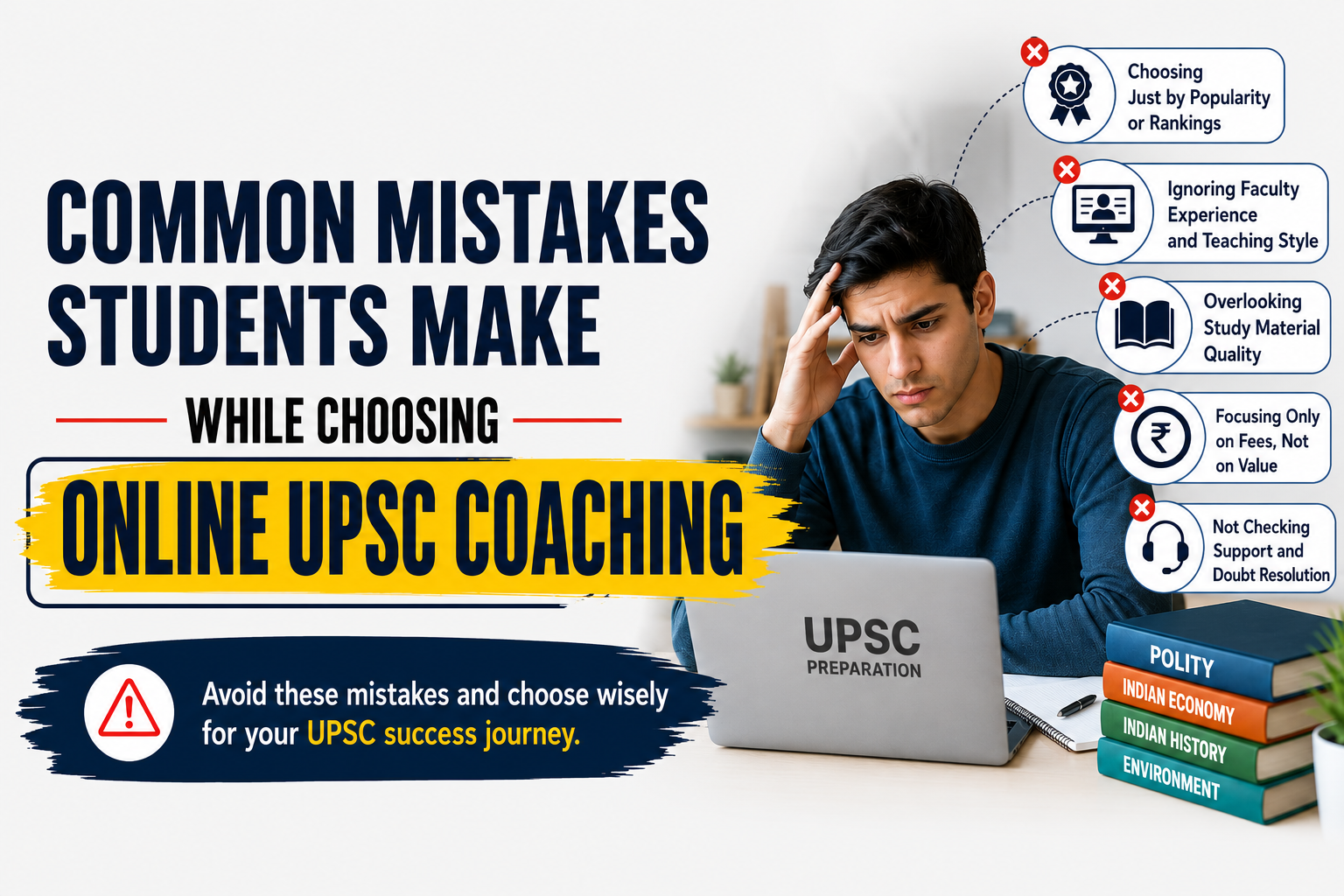
1. Choosing Coaching Only Because It is Popular
One common mistake is thinking that a popular coaching institute will automatically be the right choice for every student. An institute may have a good name, experienced teachers, and many students. But its online programme may not suit your way of learning. Online and offline classes can also be very different.
Before choosing a course, check the teachers, course plan, teaching method, mentorship, test series, study material and student reviews. Choose a programme that suits your preparation needs instead of choosing it only because the name is well known.
2. Looking Only at the Course Fee
The course fee is important, but choosing a course only because it is cheap can create problems later. A low-cost programme may not include important things such as regular answer checking, personal guidance, doubt-solving sessions, updated study material, or a complete test series.
At the same time, an expensive course is not always better. Instead of comparing only the fees, check what you are getting for the money. Look at the classes, study material, tests, mentorship, revision support, current affairs, and answer-writing guidance. Look at the value of the course, not just its price.
3. Not Checking the Teachers and Teaching Style
Teachers have an important role in UPSC preparation. However, some students join a course without checking who will teach them. Before buying an online programme, check the teachers and attend demo classes if they are available. See whether the teacher explains topics clearly, connects static topics with current affairs, and teaches according to the UPSC syllabus.
Also think about the type of teaching you prefer. Do you like detailed classes? Or do you prefer short and simple explanations? Do you prefer concept-based teaching or an exam-focused approach? A teacher who is good for one student may not be the right fit for another.
4. Ignoring the Course Structure
The UPSC syllabus is very large. It includes General Studies, Essay, Optional Subject, CSAT, current affairs, and answer writing. A course without a clear plan can make preparation difficult.
Before joining, find out:
- When does the course start and end?
- Is the complete syllabus covered?
- Are revision classes included?
- How often are tests conducted?
- Is answer writing included?
- Are current affairs connected with the syllabus?
- Are recorded classes available?
- How long can you access the content?
A clear timetable will help you understand whether you can follow the course along with your preparation schedule.
5. Choosing a Course Without Checking the Study Material
Good study material can save a lot of time during UPSC preparation. A common mistake is assuming that every online course provides good study material.
Before joining, check sample PDFs, notes, current-affairs material, question banks, and other resources if they are available.
The study material should be based on the UPSC syllabus and should help you revise. It should not simply add more information to study. Remember, UPSC preparation is not about collecting as many books and PDFs as possible. It is about understanding topics, revising them, improving your thinking, and practising answer writing.
6. Ignoring Doubt-Solving Support
Online learning gives you flexibility, but it can also mean less direct interaction. This is why you should check how the course handles doubts. Some programmes provide doubt-solving classes, discussion forums, live interaction, or direct contact with mentors. Others mainly provide recorded classes.
Ask yourself whether you are comfortable studying on your own or whether you need regular help from teachers and mentors. Getting your doubts cleared on time can stop small gaps in understanding from becoming bigger problems later.
7. Assuming Recorded Classes Are Enough
Recorded classes are useful because you can watch them according to your schedule. But this flexibility can also lead to delays. Students may buy a large recorded course and keep postponing the lectures. After some time, a large backlog can build up.
Before choosing a recorded programme, think about your own discipline. If you find it difficult to follow a schedule on your own, a programme with live classes, regular tests, deadlines and mentorship may be better for you. The best online course is not the one with the most videos. It is the one you can complete and revise regularly.
8. Ignoring the Test Series and Answer-Writing Programme
UPSC preparation is not only about watching lectures. Regular practice is also important, especially for Mains.
Before joining a coaching programme, check whether it provides:
- Prelims mock tests
- Mains answer-writing practice
- Essay tests
- CSAT practice
- Model answers
- Performance analysis
- Timely checking and feedback
A good test programme should help you find your weak areas and improve your speed, answer structure, content and presentation.
9. Depending Too Much on Online Reviews
Reviews can be helpful, but depending only on them can be misleading.
Every student has different needs. One student may like detailed classes, while another may prefer short classes focused on revision.
Instead of depending on a few reviews, check reviews from different sources and look for common feedback. More importantly, attend demo classes and check the course details yourself. Your own experience should be more important than promotional reviews.
10. Not Checking Technical and Access Features
Online coaching depends on technology, so these details should not be ignored.
Before joining, check whether the platform works properly on your phone or laptop and whether you can attend classes with a reliable internet connection.
Also check:
- Mobile and laptop compatibility
- Video quality
- Download options, if provided
- Lecture validity
- Access period
- Availability of recorded classes
- Test platform
- Customer support
These details can affect your online learning experience.
11. Choosing Too Many Courses at Once
Another common mistake is buying many courses from different platforms because each one looks useful. For example, an aspirant may buy one GS course, another current-affairs programme, several test series, multiple optional-subject courses, and many PDF compilations.
This can lead to too much study material and confusion. Instead of always looking for new resources, choose a reliable set of resources and focus on completing and revising them.
12. Not Considering Your Learning Style
There is no single online UPSC course that is perfect for every student. Some students learn well through recorded classes. Others need live interaction. Some prefer detailed notes, while others prefer self-study with tests and mentorship.
Before making a decision, understand your strengths, weaknesses, schedule, previous preparation and ability to study on your own. For example, a working professional may prefer recorded classes because they offer more flexibility. A beginner may benefit more from live classes, a fixed schedule and regular guidance.
13. Getting Influenced by Discounts and Marketing
Limited-time offers, big discounts, free modules, well-known teachers, and claims of good results can influence students when they are choosing a course. However, an attractive offer should not be the main reason for choosing a UPSC course.
First, check the teaching quality and whether the programme suits your needs. Consider the discount only after you are sure that the course is right for you.
Related Article Read More:
How to Choose the Right Online UPSC Coaching?
Before making your final decision, make a simple checklist which will help you to make the right decision.
- An experienced faculty
- Course structure
- Study material
- Mentorship
- Test series
- Answer writing
- Doubt session
Most importantly, remember that coaching is a support system, not a replacement for self-study. UPSC preparation requires regular reading, revision, current-affairs analysis, practice and self-assessment.
Conclusion
Choosing online UPSC coaching is an important decision, but it does not have to be difficult. The biggest mistake is choosing a programme only because of its popularity, price or marketing. Instead, check whether the programme suits your learning style, preparation level, schedule, budget and needs.
A good online UPSC coaching programme should give you proper guidance while also helping you develop your own study habits. The usefulness of a coaching programme depends not only on the quality of teaching but also on how regularly you use the resources.
Compare the full course, attend demo classes, review the teachers and course details, and understand what support you need before deciding. Choose a programme that helps you study regularly, practise, revise, and move closer to your UPSC goal with more clarity and confidence.